Mother’s Day 2026: The Threads That Hold Us
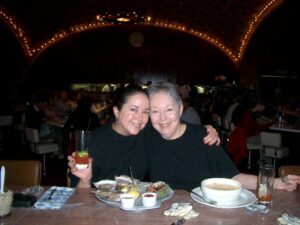
November, 2005: Debbie and Maryanne at the Grand Central Oyster Bar (NYC), three years prior to Maryanne’s passing
This will be my ninth Mother’s Day blog since 2017, when I started honoring Mom in this way. Every year I wonder if I’ll run out of things to say, but so far that hasn’t happened.
If anything, my well on this topic feels deeper with time.
This year, that depth was stirred in a new way through a conversation with my cousin Kay, when we sat down recently to reflect on our moms (her mother Sydna and my mother Maryanne) - two women whose lives were intertwined long before we came along, and whose influence continues to shape us in ways both obvious and subtle.
Our families have been connected for well over 70 years. Our parents hung out together as young couples in the early 1950s - double dating, building lives, raising families. Kay and I grew up not just as cousins, but as part of a shared story. That kind of continuity is rare. And as we get older, we see more clearly what a gift that has been.
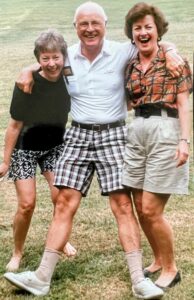
Circa Late 90’s: Maryanne, Gage (Kay’s Father), and Sydna, in their mid-60’s
When we talked, what struck me most was not just what our mothers did, but how they lived.
They were strong. Not in a performative way, but in the quiet, determined, get-on-with-it kind of way that defined their generation. They built careers when that was far from guaranteed. They managed households through uncertainty. They made hard decisions and lived with the consequences.
My mom started as an executive secretary and worked her way into a purchasing role in a major Fortune 500 company, at a time when that kind of progression for a woman was anything but typical. She did it through persistence, capability, and a refusal to accept the limits placed in front of her.
Sydna’s path was equally dynamic, spanning multiple careers over her lifetime, and also including a Fortune 500 management stint. Both of them showed us, without ever making a speech about it, that women could define their own directions.
Looking back, I realize how much of my own approach to life came from simply being able to SEE what might be possible!
Our moms also took care of themselves in ways that feel surprisingly modern. They paid attention to what they ate. They moved their bodies. Not in extreme ways, but consistently. They consulted with doctors as partners, experimenting with which approaches would work best for their individual situations. There was a sense of stewardship about their health and longevity that I’ve come to appreciate even more with time.
And then there was the practicality.
Financial responsibility. Planning. Making sure the essentials were covered, even when things were tight. I remember those years after my parents’ divorce, when my mom was raising three daughters on her own. We didn’t have everything we wanted. But we had what we needed, and we never felt shorted on holidays and experiences. Most importantly, we had a front-row seat to what resilience looks like.
These lessons have stayed with me.
One story I shared with Kay says it all. When it looked like I wouldn’t be able to go to college due to a technicality in financial aid, my mom simply refused to accept it. She found another path. Grants. Loans. Her mindset was clear: this child is going to college. And that was that.
Where there’s a will, there’s a way.
I’ve written those words before. I understand them more deeply now.
My conversation with Kay also brought back so many small, vivid memories. Traveling together. Navigating the world with our moms as they got older. Figuring out how to make things work so they could continue to participate fully in life.
That, in many ways, is the heart of caregiving.
Not just helping with the hard moments, but creating the conditions for joy to continue. Making space for a seat in a crowded jazz club in New Orleans. Finding a way to get to the theater in New York. Driving into the Blue Ridge Mountains to see the glorious turn of the leaves. Slowing down the pace just enough so everyone can be included.
It’s not always easy. But it matters.
And then there are the objects.
Over the years, I’ve written about the things I’ve kept. The clothes. The family roasting pan. The treasure-trove of letters and cards I still can’t quite bring myself to read all the way through. That hasn’t changed.
What has changed is how I think about them.
They’re not just mementos. They’re touchpoints. A way to access something that doesn’t disappear when a person is gone.
Kay and I laughed about the little ways our moms still show up. A gesture. A phrase. A habit you catch yourself doing and suddenly realize, “That’s her.”
In my case, it’s often the way I think. The standards I hold. The drive to keep going, even when it would be easier not to.
And perhaps most of all, the desire to make her proud.
Even now.
One of the things Kay said during our conversation stayed with me. She’s been creating new traditions to honor her mom since her passing less than two years ago. Lighting a candle. Playing her mom’s favorite music. Organizing photo books. Feeling the energy of Grandma’s gold necklace, with all 13 of our cousins’ charms hanging from it!
It’s a simple idea, but a powerful one.
Because remembrance isn’t passive. It’s something we can actively shape.
For me, having lost Mom nearly 18 years ago, I’ve been thinking about “when” will be the right time to finally open that box of letters. But on many days, I simply pause, on a quiet morning, to reflect on what my mom gave me and how I’m carrying that forward.
This Mother’s Day, I find myself thinking about legacy.
Not in a grand sense, but in the everyday ways it lives on. In how we show up. In how we handle challenges. In how we care for others.
And in how we stay connected to those who shaped us.
If your mom is still here, I hope you savor this time with her. Truly savor it.
If she’s not still with us, I hope you find your own special way to keep that connection alive.
Because if there’s one thing I’m more certain of with each passing year, it’s this:
Our loved ones never really leave us. They become part of how we live, every day.
*Please know that I'm not an affiliate for any of the websites/ companies or sources quoted herein, nor am I nor AMI/ The Caregiving Journey compensated by them in any way unless otherwise stated; I am simply sharing various links and resources that you may find helpful and informative.
Thank you for reading our blog – we hope you enjoyed it!
If you‘d like to receive our free tips to help you with your caregiving challenges, please subscribe to our newsletter/ blog. When you sign up, you’ll receive FREE access to our private resource library of tips to help you navigate each of the three key phases of your caregiving journey:
- Planning
- Surviving and thriving
- Relaunching when caregiving is done
We also give you guidance for your own self-care, and specific tips for planning for caregiving.
We welcome you!